Remote since 2018: the setup that carried us through COVID and the war
RemSoft stands for remote software development. A company that went remote by choice in 2018 explains how it works: fixed deadlines and meetings for the client, free hours and place for the developer, and why that held in 2020 and 2022.
Business
6 min
Mark PodliashetskyiCEO
Share:
In 2017 we had an office for about twenty people. Developers, managers, the usual kitchen. In 2018 the rent contract ended, and instead of signing the next one we decided to try remote. Nobody made us do it. It was that simple.
Two years later, in March 2020, companies everywhere found out within a week whether their remote processes existed in practice or only on paper. Four years later, in February 2022, our team in Ukraine faced something far worse. Both times the work continued. The reason is not heroics. The hard part had been done years earlier, when nothing was forcing us to do it.
The first year was the hard one
Leaving the office is easy. What follows is a long list of questions you never had to answer when everyone sat in one room. How does a developer get secure access to a client's systems from home? Who sees what? How do you know work is moving without watching people? When does a question need a call, and when is a written answer enough? What does a working day even mean when nobody arrives at nine?
We answered those one at a time: rules for security and access, how work is planned and tracked, how we communicate with each other and with clients, what is fixed and what is free.
The rule that mattered most: no unnecessary calls. Everything gets solved in writing. When a call does happen, it ends with a written follow up, so the decision exists somewhere other than in two people's memory. On a remote team everything has to be documented more thoroughly and more carefully than it ever was in an office, because there is no corridor where someone can ask what was meant.
It was difficult to set up. Later it became very easy, and today it is simply how we work. But I want to be honest about the order: the easy part came after the difficult part.
How we work
The principle underneath everything: we deliver tasks, not hours.
For a client the agreement is simple. You get what was agreed, when it was agreed. The meetings we set together are fixed: if a project has a daily call at ten or a weekly review on Thursdays, everyone is there. If something needs discussing, we are available for a short call, and most questions get a written answer.
Everything else is free. Our developers choose their hours and their place, and they take time off when they need it. Someone who works best from six in the morning does that. Someone who starts after lunch does that. Time tracking exists only where a client's contract asks for it. That is the whole deal: fixed commitments to the client, free time for the developer.
Why this way? Because a developer's time is the most valuable thing this company has, and what a client pays for is what that time produces. Hours spent in traffic, in meetings held because the room was booked, or at a desk in order to be seen are hours not spent on the problem. Remove them, and people do their best work when they are at their best, which is rarely the same hour for everyone.
We deliver tasks, not hours.
March 2020: COVID
COVID hit. Many companies that had never worked remotely had to invent processes and controls while trying to keep working at the same time. Who has access to what, how to run a meeting, how to know whether anything is happening. We didn't have to rebuild our processes overnight. For us nothing changed in how work was done: the same tools, the same rules, the same meetings.
February 2022: Full-scale invasion and blackouts
Then Russia launched its full-scale invasion. Most of our team is in Ukraine. For the first two or three weeks we worked partially, like everyone there did. We did not force anyone to work; people had more important things to deal with.
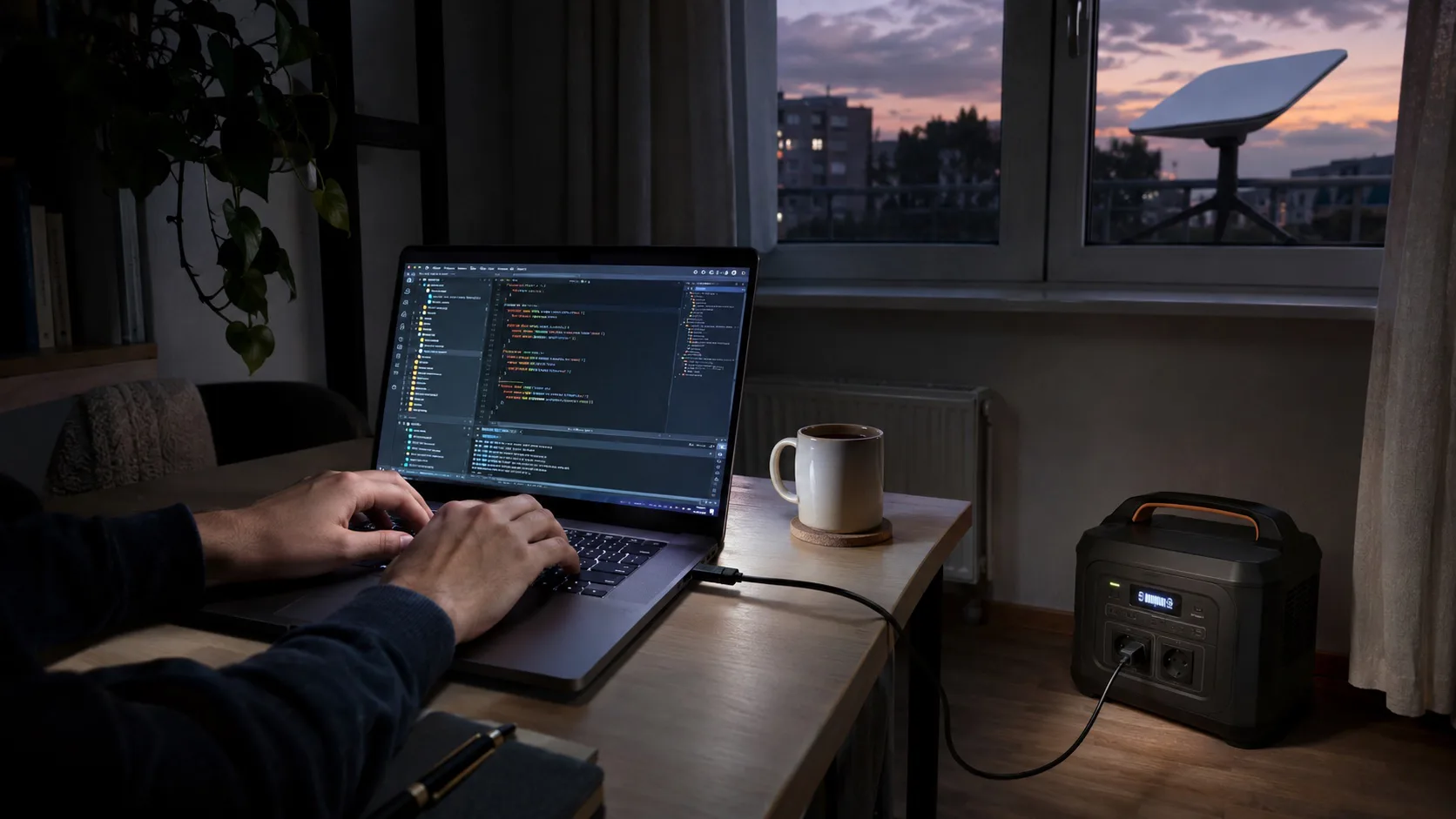
After that we continued. The harder test came with the blackouts, when electricity went off for hours at a time. Our developers stayed online because they had what they needed. We started with Starlink terminals and power stations for the key people, the ones who could handle everything while others were offline. With time we covered everyone with power stations.
Clients stayed with us and deadlines were met. That is the whole result, and I am not going to dress it up with numbers.
Remote work in Austria in 2026
In November 2026, Wiener Wirtschaft reported on the Flexible Working study by Deloitte Österreich from September 2026, a survey of 484 employees and company representatives. A few numbers from it, because they describe the gap we live in.
In 70 percent of Austrian companies home office is possible for at least half of the staff, and the most common model is two or three remote days a week. 85 percent of employees and companies say it makes an employer more attractive. Trust is high on both sides: 77 percent of company representatives and 81 percent of employees say so.
Then the gap. 74 percent of employees rate the effect of home office on productivity as positive. Only 54 percent of company representatives do. Employees want more remote days, companies want fewer. And working remotely from abroad is still rare: 53 percent say their company does not allow it, and only 2 percent work six weeks or more from another country.
Deloitte's HR expert Katrin Hintermeier draws the conclusion for managers: presence is not a reliable measure of performance, so define goals, responsibilities and expected results and organise the work around those. That is the conclusion we reached in 2018, from the other direction. When you cannot see people, you have to measure what they deliver. Once you measure what they deliver, you no longer need to see them.
For us the 2 percent is not an exception, it is the company. I am in Vienna. The team works from Ukraine and other EU countries.
What is hard about it
Working from home is not always easy, especially when you share your space with family. Distractions, limited privacy, and the lack of a dedicated workspace can make it difficult to focus. No amount of process can fully solve that.
And the setup itself, at the beginning. Those have been the two most persistent challenges for us.
Why I am writing this
Two readers in mind.
Clients: this is why a team based largely in Ukraine has kept delivering through 2020 and 2022, and why "where is your team" is a question we are happy to answer. The team works from Ukraine and other EU countries, 27 people today, each of them choosing their own hours.
Founders: if you can go remote before you must, do it. The processes you build in calm years are the ones that hold in bad ones, and you will not have time to build them when the bad year arrives.
We left the office in 2018 because a rent contract ended. It turned out to be the most important decision we made before 2020, and later it gave the company its name: RemSoft, remote software development.